What is external interference?

There has been discussion in some of the AS 2885 committees about exactly what “external interference” includes. It is probably fair to say that the meaning of “external interference” seemed so clear and obvious to those involved in drafting the various revisions of Parts 1 and 6, over many years, that it never occurred to us that an explicit definition would be needed. That now looks like an oversight as some misunderstanding has developed.

The nearest thing we have to a definition is unfortunately buried in Clause C6.1 of Appendix C to Part 6:

The nature of external interference involves the removal or penetration of the protective ground cover and contact with the pipe.

Even that is not quite complete because it leaves unstated that external interference is a result of human activity and does not include natural events. So external interference is intended to cover only those threats that involve direct impact to the pipe during excavation (including digging, boring or any other ground-penetrating activity).

This is not new, and in fact has been a fundamental aspect of the safety management process ever since the concept of risk assessment was introduced in the 1997 revision of Part 1 (i.e. 24 years ago!). The whole SMS process is based on two broad categories of threat:

  • External interference
  • Everything else (corrosion, natural events, design or construction shortcomings, operational shortcomings, etc)

There are two reasons for this distinction:

  • Damage by direct impact to the pipe during excavation has long been known to be the overwhelmingly dominant cause of pipeline incidents and failures
  • Very specific design and operational measures can be specified by AS 2885 to mitigate such threats

From Part 1 Clause 5.4.1:

The purpose of physical controls is to prevent failure resulting from an identified external interference event by either physically preventing contact with the pipe or by providing adequate resistance to penetration in the pipe itself.

The purpose of procedural controls is to minimise the likelihood of external interference activity, with potential to damage a pipeline, occurring without the knowledge of the pipeline operator, and to maximise the likelihood of people undertaking such activity being aware of of both the presence of the pipeline and the possible consequences of damaging it.

Clause 5.4.4 and Tables 5.4.4(A) and (B) then go on to specify that physical protection measures must include both separation and resistance to penetration (with multiple subcategories), and that procedural protection must include both pipeline awareness and external interference detection (again with multiple subcategories)

All these requirements (and the further much more detailed requirements) are focussed specifically on protection against excavation activities, and make little or no sense for other types of threat.

So it is simply not correct to classify as “external interference” threats such as:

  • external loads due to vehicles (no contact with pipe or possibility of penetration)
  • ground movement (not human-caused, no possibility of penetration although severe deformation may cause rupture)
  • exposure of the pipe due to erosion (ditto)
  • anything else to which the principles of physical and procedure protection against human-caused impact and penetration don’t make sense

Above-ground pipes may look like a grey area, since removal of ground cover is obviously not applicable. However the other principles of protection by separation and penetration resistance are still relevant, as are procedural measures. So the external interference rules are still relevant to threats such as vehicle impact on aboveground pipe.

Everyone involved in pipeline safety management studies should be aware of what constitutes external interference, whether the SMS is for design or operational purposes.
Barred tee fabrication

We’ve been quiet lately, for a whole lot of reasons largely related to being a volunteer team. But there has been a recent update to AS2885.info with guidance on how to fabricate a barred tee without welding in the area of the extrusion neck. It’s the second item on this page and also copied below.

It is interesting that this method was normal practice at least 40 years ago, but sometimes old knowledge can be lost if it is not documented somewhere such as in a Standard as has now been done.

Barred tees: What is the reason behind the addition of Clause 5.6.2(e) in AS 2885.2-2016 (Clause 5.6.2(d) in 2020 version), which states that “pig bars shall not be welded directly to the high stress areas around the extrusion neck”?

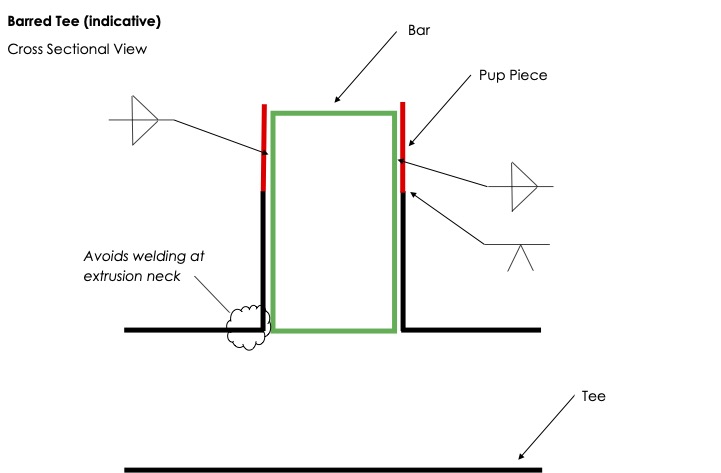
On any forged fitting it is recommended to only weld at the weld preparation area, as stresses caused by welding can cause cracking at subsurface features such as laminations. This is often not detected using Magnetic Particle Inspection unless it is surface breaking. The passage of the pig could then cause failure of the bars and a stuck pig scenario.

The diagram below is a guide (not definitive) showing how the pig bars are welded to the pup piece rather than the extruded neck.

Webinars – Demonstration of Conformance and others

The webinar on 4 August, 2021 (mentioned in an earlier post) was a very successful and popular session with a panel of presenters giving multiple perspectives on how conformance with AS 2885 can be demonstrated in a range of contexts. For those unable to join in, or who want to revisit any aspect, it was recorded and is now available for viewing here.

In fact there is a bunch of previous AS 2885 webinars here. Most run for about an hour but this latest one is about 2 hours because of the number of panellists.

Fracture toughness for components

Fracture control can be complicated enough without the additional subtleties of things other than mainline pipe. It is not surprising that questions arise in this area.

AS2885.info has had a couple of recent additions dealing with Charpy testing for pipeline components – specifically hot tap fittings and flanged valves. These are quite specific issues but may also provide you with some guidance on how to handle other similar topics. And if there are other aspects that are not clear feel free to comment here or email info@as2885.info.

AS 2885 supporting documents

We have added to AS2885.info some links to potentially important background information, with the relevant page copied verbatim below. The documents were originally published over 10 years ago and became unavailable for a while but remain important.

This is not exactly bedtime reading. In fact parts of it can be quite dense and difficult to digest. But sometimes if you are grappling with the interpretation of AS 2885, or trying to understand why it says what it does, you might find this useful. In fact, you might as well download the two documents right now and file them somewhere handy.


In preparing each revision of AS 2885 the committees have often prepared Issue Papers that discuss a topic in detail and conclude with recommended changes to the Standard. These are working papers that tend to be abandoned when sufficient work has been done to reach a recommendation, even though the document may in some ways be incomplete or unpolished. For this reason most are not suitable for publication. However for the revision of Part 1 in 2007 nearly 80 Issue Papers were prepared and later edited for publication in 2010.

Since 2010 all Parts of AS 2885 have been revised, in some cases very substantially. However each revision of a Standard tends to build on the work of the previous revision. Hence much of the 2010 background documents remains valid as an explanation and justification for current content of Part 1 and to some extent Part 6 (which was split out from Part 1 in 2018). Users who refer to these documents must form their own judgement about the applicability to the current revision of the Standard. Note that the clause numbers referred to in the Issue Papers are for AS 2885.1-2007 and will be different for the 2018 Standards.

This Issue Paper publication project resulted in two large PDF documents:

  • “The APIA Guide to AS 2885”, August 2010
  • Appendix 2 to the Guide, “Issue Papers Prepared as Basis for AS 2885.1, Revision 2007”

APGA members can download them from the APGA Knowledgebase. Due to idiosyncrasies in the Knowledgebase metadata they are best found by searching for the date on which they were added to the Knowledgebase: 12/07/2021.

Some pages in this AS2885.info wiki refer to specific Issue Papers from the 2010 suite.


Over 60 Issue Papers were prepared prior to the 2018 revisions of Parts 1 and 6 but remain in their incomplete and unpolished state. The intellectual property of these papers lies with APGA. They may or may not be made publicly available in future. Requests for background information or copies of particular Issue Papers will be considered and may be granted depending on circumstances.

Demonstration of Conformance – webinar

APGA and some of the AS2885.info team have organised an online seminar about demonstration of conformance with AS 2885, 11:30 am – 1:30 pm Wednesday, 4 August, 2021.


Join us for a very special webinar event as APGA and members of the AS2885.info project team host an online workshop for presentations and discussion on matters relevant to conformance with the AS 2885 suite of Standards. The webinar will be a hybrid interactive format, and if you have been involved in demonstration of conformance with a story to tell, you are invited to join us as a panel member.

Pipeline design, construction, operation and maintenance must be done in a manner that conforms with the requirements of the AS 2885 Standard which is referenced in Australian legislation and regulation. But the way conformance should be determined and documented (and why) is not set out in any written guidelines. 

This webinar seeks to raise awareness of the various ways in which conformance can be demonstrated in the pipeline industry today. The webinar is not intended to provide definitive answers to conformance, but to discuss the various ways to do it.

The basic questions relevant to the discussion are:

·         When is assurance of conformance required?

·         Who should provide assurance of conformance, how, and why?

·         How can the client, licensee, or the regulator be confident that conformance has been achieved?

If you work with AS 2885 and have ever been asked to demonstrate conformance to the Standard, this workshop is for you. You can attend as a webinar guest (not visible to attendees), or as a Panel Member (visible on screen).

Panel members will include the AS2885.info team and invited industry members, with Susan Jaques acting as facilitator. 

Outstanding Questions

The AS2885.info team has accrued a backlog of questions from various sources. We are working through them to add to AS2885.info, but users might be interested to see what’s in the list. This is a high-level summary of topics, some of which concern quite specific and detailed questions.

  • Welding on barred tees (Part 2)
  • Weld impact testing (Part 2)
  • Error in Equation B2(1) (Part 5)
  • Weld anomaly assessment (Parts 2 & 3)
  • Interpretation of incident severity in SMS (Part 6)
  • Radiation contour calculation (Part 6)
  • Strength Test Type 2 (Part 5)
  • Exclusions zones (Part 5)
  • Fracture control, hot tap fittings (Part 1)
  • “Pipestrain” usage (Parts 1 & 5)
  • External loads (Part 1)
  • Critical defect length (Part 1)

To get the best out of this blog …

If you have a question of any sort about interpretation of AS 2885 feel free to comment on this post or contact the AS2885.info team via the Contact page. Someone in the team will respond (eventually – most of us have busy day jobs).

This blog exists to help users of the AS 2885 suite of Standards. It is a companion to the wiki at AS2885.info and is the best way to raise questions to be added to the wiki for the benefit of all users of AS 2885. For more information about both sites see the About page.