AS4822:2024

The standard for field joint coatings, AS4822, is included in ME-038’s portfolio.  We usually just refer to AS2885, but AS4822 is part of the team too.

This makes sense, because what other committee would look after a standard about coating joints of pipelines in the field? 

So also, there’s an argument that in the ‘one document’ scenario for AS2885, maybe that we roll in the AS4822 content as well.  So that’s another 67 pages. 

Sixty-seven pages of very specific information, specific to the coatings we put on those welded joints in the field. 

AS4822 covers topics such as the application procedure specification, and the surface preparation requirements, and then the specific requirements of 5 types of field-applied coatings: 

  • Petrolatum and polymeric tape coatings
  • Heat-shrinkable coatings
  • Fusion-bonded epoxy coatings
  • Liquid applied coatings
  • Amorphous low viscosity polyolefin coatings (ALVPC)

AS4822:2018 has now been revised, and will be published on or about October 18th, 2024

According to the preface, the major changes between 2018 and 2024 are:

  1. Type tests are more clearly identified and a definition has been added
  2. Some tests have been reclassified as Type tests.
  3. An electrical resistivity type test has been added for liquid applied coatings.
  4. The peel rate for polymetric tape lab testing has been changed to align with the rate used for field testing.
  5. Some peel test requirements have been changed for tape coatings and ALVPC.

Reading those changes makes me think the content of this Standard is very unique to those in the coatings arena, and maybe inclusion in the wider AS2885 isn’t wise.  So, I’m looking for those for and against this idea to let me know why, either way.

On another thought train, AS2885.1 Section 8 is Corrosion Management.  When I’m talking to new members of the industry about coatings, and how to choose them, I often say, if you want to know which coating is the best, just ask the salesperson, they’ll tell you.  (!)  And then I remark that it’s really important to know what factors are important to your project, so that the right coating is specified. 

I mentioned this, that we don’t provide much guidance to decide on coatings, to the esteemed Geoff Cope, former chair of many corrosion/coating related committees and groups.  I mentioned that we don’t really give much guidance in AS2885 to help a person choose which coating to specify.  This was probably more of a decision issue when Yellowjacket HDPE coating was in competition with FBE coating… but I wonder if we could still give more guidance here.

Geoff Cope pointed me to some appendices in AS4822 for coating purchasing assistance. 

Appendix A of AS4822:2024 provides a list of “Purchasing Guidelines”. The appendix contains “advice and recommendations on the information to be supplied by the purchaser at the time of inquiry and order and by the coating applicator.  It aims to avoid misunderstanding and to result in the purchaser receiving satisfactory products and service.” 

There’s also Appendix K of AS4822:2024, which is a “Guide to compatibility of coatings”, which, in table format, advises on the suitable compatibility of four pipeline coatings used in Australia (FBE to AS4321, Extruded 2-layer polyethylene, FBE to AS3862, and 3-layer polyolefin), against seven Field Joint Coating types.

Lots about coatings to get one’s head around!

Thanks to the ME-038-08 subcommittee which looks after the corrosion/coating standards, AS4822 and AS3862.  The current convenor of that subcommittee is David Anderson.  Thanks to all subcommittee members for your hard work, in particular in this case Ashley Fletcher who did an enormous amount of detailed wordsmithing for this revision of AS4822.

Susan, September 30, 2024

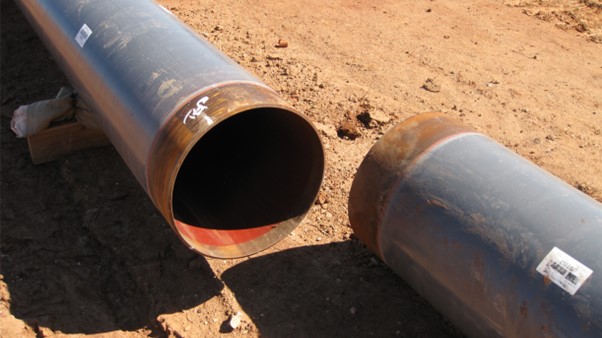
Field joints waiting to be welded, and then the bare steel will be coated in the field, to prevent corrosion.

Contributors and Contributions

In late August, I went to a Standards Australia “Contributor Forum 2024”.  These contributor forums are, according to Standards Australia “an opportunity to come together to share initiatives we have delivered or are currently in progress, and seek feedback and insights to areas of focus where we can deliver the greatest value to our stakeholders.”

These have been done annually for awhile; the last one I went to was in 2019. 

The thing with getting feedback, is actually taking it on board and then reporting back.

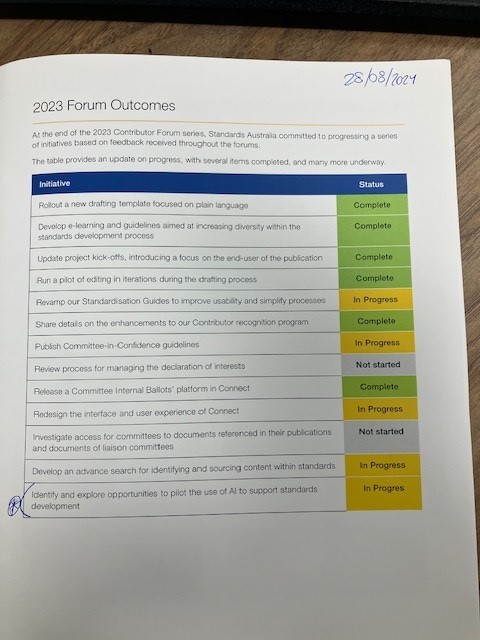
I was pleased to see in the first few pages, a clear table of the status from 2023:

The item I like is the last one – the use of AI to support standards development.

This is an item I raised as an opportunity to really streamline and speed up the production of Standards.  Really, all that time spent on cross-references, grammar, and nitty-gritty details are perfect for AI to take over the bulk of the “styling and editing” that seems to take months currently.

Other noteworthy focuses are:

  • An “onboarding manager” for new committee members
  • Better guidelines about ‘committee in confidence” and what that means. … The quip at the time was that, once you join a standards committee, what, you’re not allowed to talk about standards anymore?
  • Management of conflicts of interest process is getting a review.

Something that gets muddled up a lot is when Standards Australia asks themselves “who are our customers”.  Their answer is:

  • Users of the standard
  • Standards development (proposals, drafting, publications)
  • Internal (employee Experience)
  • Nominating Organisations
  • Buyers of the standard
  • Members of the public
  • Committee members

This is a thorough list.  The problem is, that is a very diverse list of seven.  The user of a standard (who doesn’t even know who was on the committee) is very different to the committee members who wrote it (and therefore have a more deep knowledge of how it got there). 

That’s why we developed our wiki, and this blog.  It’s to serve the first on that list: the user of the standard.  We’re here to help.

And so, after the Forum concluded, we had some lovely drinks under the Story Bridge, and I got to chat with people who are involved in a plethora of standards:  wood, electrical, HVAC, and digitisation.  I’m glad I went.

To close out this post with some good news:  the ME-038 Main Committee has a new Project Manager.  We’ve appreciated Andrew McKay for many years, and we wish him well as he moves onto other committees and roles, still within Standards. 

Our new PM, Simon, is young, just 2 years with Standards so far…. and he has a legal/law background from uni/studies.  I think that will be fantastic.

And the best part is, when I mentioned to him our audacious goal to combine the seven parts of AS2885 into one, he said, oh yeah, ok, …I’m going through that right now with another committee. 

“Great, so you’ve got some recent experience”.

“Yes.  And, you should know:  they have spent the last six months meeting every two weeks, to resolve all of the fiddly overlaps, repeats and contradictions they keep finding.”

“Ah.  Ok”   
*puts note into 2028 calendar:  busy all year on AS2885*

Susan
September 9th, 2024

What interests you?

My recent webinar “Failure is Normal: A Tale of Two Bridges” generated some encouraging feedback, so I could be persuaded to present more webinars, if readers indicate sufficient interest.
A couple of categories of possible topics come to mind; engineering practice, and more about learning from failure.

Engineering Practice
1) The Benefits of Engaging Independent Consultants
(A discussion forum in which other independent consultants could also share their advice about how engaging independent consultants adds value to the pipeline industry.)
2) Dealing with Commercial Pressures on Engineers
(My recommendations, plus an interactive session in which attendees are invited to speak up about pressure situations they have encountered and how they dealt with them.)
3) ECI and Relationship Contracting:
• Common contracting strategy options and appropriate application for each;
• Basics of “two stage” relationship contracting, risk sharing and mitigation, workshops recommended; pitfalls, advantages and benefits.

Learning from Failure
4) Sources of disaster information – Pros and Cons of each
(Book recommendations, news articles, safety websites, Wikipedia, Royal Commissions, Inquiries, Coroner’s Reports, etc.)

If you liked “A Tale of Two Bridges”, there’s a couple more “disaster parallels” opportunities I could develop and present such as:
5) Runaway Trains: The Lac Megantic disaster and the BHP ore train in the Pilbara.
6) Deadly Thrill Rides: The Royal Adelaide Show (2014); Dreamworld (2016); and USA events.

There may be other topics that you would like to see addressed in a webinar, so just reply to let me know what interests you.
Ted Metcalfe

tedmetcalfe@bigpond.com

Venting pits, and the value of AS2885.info

There was a recent query about the requirements of AS 2885.1 for venting below-ground structures such as valve pits. It turns out the Standard is incomplete, because an editorial change in 1997 inadvertently omitted a key sentence and no-one noticed until 25 years later. Subsequent revisions of the Standard had applied the “ain’t broke, don’t fix it” principle and failed to notice the broken bit.

On the one hand the fact that no-one noticed could be interpreted as meaning that the relevant clause is in fact not very relevant at all. On the other hand, just because a requirement is not referred to very often doesn’t mean the Standard should ignore it. If and when you are designing a large below-ground pipeline structure the sealing or ventilation of it could be critically important to safety. In any case, others have possibly noticed the anomaly but had no easy way of raising the issue to get it fixed. AS2885.info provides an avenue for any user of the Standard to raise issues such as this.

So what was the problem? Clause 6.5.3 of AS 2885.1-2018 specifies that below-ground structures of less than 6 m3 volume may be sealed or vented, but is silent on larger structures. It turns out that AS 2885-1987 (note the year!) included a sentence that “Any other structure shall be ventilated.” (i.e. must not be sealed). However that sentence was lost from all subsequent revisions. More detail here.

The take-home message is that no matter how hard committees try to get AS 2885 exactly right there are things that slip through, but if you find anything that you think is incomplete, wrong, ambiguous, etc then send an email to info@as2885.info. And if you have to design a big pit, make sure it is ventilated in accordance with Part 1 Clause 6.5.2(d).

Pigging a lined pipe – response (and a record-keeping caution)

The previous post gathered a number of helpful responses from experienced industry people. But before getting to the technical responses there is an interesting sub-text to this topic, relevant to everyone in the pipeline industry. None of the following is intended to be critical of the current operator, quite the contrary – they have recognised a problem from the past and are working to resolve it.

It seems likely that somewhere in the 30 year history of this pipeline there has been a loss of important documentation (i.e. details of the lining, appropriate procedures for pigging). Like many pipelines it may have been through several ownership/management changes over its life and would not be the only pipeline to have lost records.

I once came across a pipeline for which the new owner’s bean-counters had decided not to incur the storage cost for any documents older than 7 years (the tax office rule). But the as-built documentation was older than that …

Of course the importance of keeping construction and maintenance documentation should be blindingly obvious, until it isn’t and something like this happens.

To the technical nitty-gritty about pigging a lined pipe:

  • There was a general consensus that wire brush pigging a lined pipe is not a good idea (no surprise there).
  • Lining damage may be indicated by epoxy flakes or dust found in debris from past pig runs, if there are relevant records or access to people who were involved at the time.
  • Whether lining damage matters depends on the purpose of the lining, which we don’t know. Lining is most commonly provided to reduce friction factor (increase flow and/or reduce pump/compressor cost). A flow lining which has been badly scratched is probably ineffective.
  • Flow analysis may permit back-calculation of friction factor and hence internal roughness of the pipe; there would be a lot of subtleties in the analysis, it would have to use transient flow modelling (unless the flow is perfectly steady), and may or may not be sufficiently precise to reach a clear conclusion.
  • Finally (and pedantically) to be strictly correct the lining is most unlikely to be FBE (Fusion Bonded Epoxy) – almost certainly liquid-applied epoxy.

On the basis of available information, we can’t say whether or not the existing lining has been damaged, but if the original reasons for lining the pipeline are still relevant and additional pigging runs are now needed, then the use of nylon brushes seems justified.

Pigging a lined pipeline

A question has been submitted to AS2885.info which is outside the experience of the team, so we thought we see if someone else out there is able to help:

A transmission pipeline was previously wire-brush pigged on a few occasions in the last 30 years. However the current operator has recently realised that the line has FBE internal lining.

The question:  Is there any value in using a nylon brush pig for future pig runs? Or is the lining likely to be already so damaged that further wire brushing doesn’t matter?

Conformance webinar – a late report

After the webinar on 4 August this blog reported on it very briefly here, and then Ted Metcalfe wrote the following comprehensive report that was inexcusably mislaid for a while. But better late than never …

In difficult times, we need a safe means of holding important industry conversations, and technical webinars have emerged as one way to remain connected with others in our industry and continue sharing knowledge.  A very good example was the webinar titled “Demonstration of Conformance” held 4 August, hosted by APGA and the AS2885.INFO team for discussion about conforming (or complying) with AS2885.

The webinar was recorded and is well worth watching for those who regularly use the AS2885 suite of Standards.

Selection of this particular webinar topic all started with a simple question made up well over a year ago just to test the correspondence features of the AS2885.INFO website system:

Can you advise on any recommended document formats for demonstration of compliance with AS2885?

Discussion within the AS2885.INFO team before the webinar prompted several more questions:

What does it mean to say that the work completed is in conformance with the Standard? 

How and why can demonstration of conformance be achieved?

How can we be confident that pipeline engineers have indeed understood the intent of the Standard and that the requirements of the Standard had been met?

Who has the qualifications to determine whether or not conformance has been demonstrated, and how do we know they are competent to do so?

The two-hour webinar was introduced by Karen Polglaze of APGA and then facilitated by Susan Jacques of the AS2885.INFO team.  As intended, it was much more of an interactive workshop than a simple technical presentation, and audience participation was strongly encouraged.

On screen was a Panel comprising members of the AS2885.INFO team and several others who had been approached to participate and contribute to the discussions.  The make-up of the Panel comprised representatives of owner/operator companies, the SA technical Regulator, and several experienced independent consultants.

After introductions, Peter Tuft presented some introductory slides which described the various approaches which have been used in the past and highlighted some of the complexities and issues associated with the concept of conformance.

The team clarified that:

  • While conformance demonstration is most often a Part 1 matter, the webinar scope intentionally included all Parts of AS2885, and that
  • The webinar was not intended to result in written recommendation guidelines but simply to increase awareness.

Each of the Panel members expressed their views on the matter based on many years of experience in the industry, and then the Panel remained on screen to field questions during discussion which followed.  The panel was well balanced, and all of their presentations were valid perspectives for consideration. 

Panel members were largely in agreement on most issues. It all went very well, and the entire two hours was filled with spirited discussion.  At least 75 of the original 100 attendees were still online near the end, so attention remained high.  Some challenges from the floor were welcomed and indicated that attendees were listening carefully.  

It was interesting that the concept of competence came up many times in discussion of getting demonstration of conformance right, prompting a further question:  

Who decides whether or not certain requirements of the Standard are both relevant and applicable?

Maybe the Pipeline Engineer Competency System needs a new competency defined here!

Discussion of the Technical Authority concept provided an opportunity to introduce the recently completed Engineering Practice Guide.  Discussion included the vexing issue of balancing cost and schedule imperatives with engineering outcomes.

Maybe the concept of conformance could be included in the next revision of the Engineering Practice Guide.

A recording of the webinar is available here.

If you would like to make further comment after watching the recording, contact the AS2885.INFO team via email at info@as2885.info or leave a reply below.

Demonstration of Conformance – webinar

APGA and some of the AS2885.info team have organised an online seminar about demonstration of conformance with AS 2885, 11:30 am – 1:30 pm Wednesday, 4 August, 2021.


Join us for a very special webinar event as APGA and members of the AS2885.info project team host an online workshop for presentations and discussion on matters relevant to conformance with the AS 2885 suite of Standards. The webinar will be a hybrid interactive format, and if you have been involved in demonstration of conformance with a story to tell, you are invited to join us as a panel member.

Pipeline design, construction, operation and maintenance must be done in a manner that conforms with the requirements of the AS 2885 Standard which is referenced in Australian legislation and regulation. But the way conformance should be determined and documented (and why) is not set out in any written guidelines. 

This webinar seeks to raise awareness of the various ways in which conformance can be demonstrated in the pipeline industry today. The webinar is not intended to provide definitive answers to conformance, but to discuss the various ways to do it.

The basic questions relevant to the discussion are:

·         When is assurance of conformance required?

·         Who should provide assurance of conformance, how, and why?

·         How can the client, licensee, or the regulator be confident that conformance has been achieved?

If you work with AS 2885 and have ever been asked to demonstrate conformance to the Standard, this workshop is for you. You can attend as a webinar guest (not visible to attendees), or as a Panel Member (visible on screen).

Panel members will include the AS2885.info team and invited industry members, with Susan Jaques acting as facilitator. 

Outstanding Questions

The AS2885.info team has accrued a backlog of questions from various sources. We are working through them to add to AS2885.info, but users might be interested to see what’s in the list. This is a high-level summary of topics, some of which concern quite specific and detailed questions.

  • Welding on barred tees (Part 2)
  • Weld impact testing (Part 2)
  • Error in Equation B2(1) (Part 5)
  • Weld anomaly assessment (Parts 2 & 3)
  • Interpretation of incident severity in SMS (Part 6)
  • Radiation contour calculation (Part 6)
  • Strength Test Type 2 (Part 5)
  • Exclusions zones (Part 5)
  • Fracture control, hot tap fittings (Part 1)
  • “Pipestrain” usage (Parts 1 & 5)
  • External loads (Part 1)
  • Critical defect length (Part 1)