This link may not be functional forever. I have a copy of an mp4 file, and will post it if this link stops working.
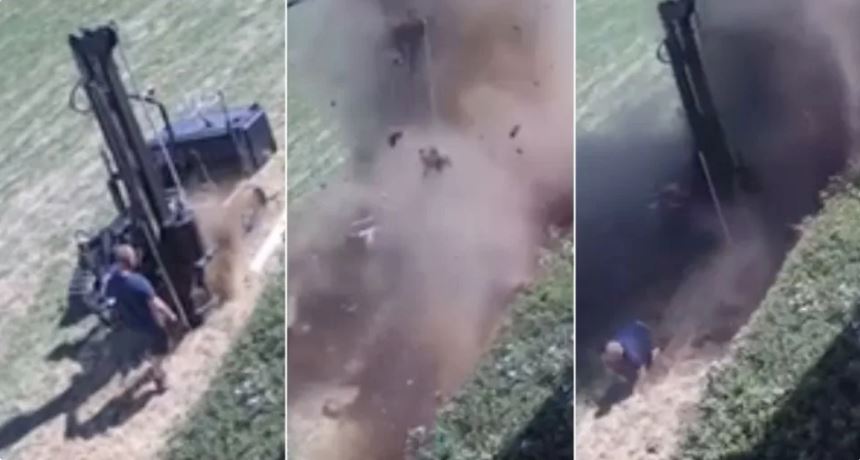
A fencing contractor is doing his job, and then gets a fright.
Many risk reviews (AS2885 Safety Management Studies) try to address this clear threat to pipelines. Depth of cover goes some way, but awareness is what we often end up relying upon.
So the problem is, preventing this often relies on the behaviour of others.
This is not always science, it’s psychology.
The question is: why was the fencing contractor not aware of the buried service?
So maybe consider more than the unfortunate fencing contractor. What about the pipeline operator’s community/land user liaison program?
Gaining awareness of things which have not turned out well for others helps us to get better at what we do so that we don’t repeat mistakes others have made.
Industry codes and standards record the wisdom and experience accumulated by many engineers over many years for the benefit of all engineers, and these need to be updated regularly for various reasons including knowledge of things which have not turned out well.
In his book The Making of an Expert Engineer, Prof. James Trevelyan states at Page 57:
Technical standards have been created through the experience of other engineers and are carefully negotiated within each specialised engineering discipline, striking a balance between restrictions to promote safety and ease of use, while also avoiding constraints that would inhibit innovation and design freedom.
That’s an excellent description of what the engineers on our Standards committees do all the time.
In the Australian pipeline industry we have an excellent Standard (AS 2885) to work with because we revise it regularly to keep up to date with new information. Awareness of poor outcomes is one of the things that has informed the continued evolution of the Australian Standard in a way that pipeline engineers in other countries envy.
Here’s some examples of links between past events and the current Standard:
Part 1 Clause 13.2 (a) requires project design records include as-built data.
Example: Due to a contractual issue, the as-built survey data for an HDD was not provided to the client. A few years later, during third-party works near the HDD, the original design drawings were assumed to be accurate. They were not. The third-party works punctured the pipeline far below the surface, and the client ended up replacing the entire HDD string.
The AS2885 suite requires detailed attention to SCC and Fracture Control. In 1982, a major rupture of the Moomba Sydney Pipeline over some distance prompted a lot of research and investigation associated with Stress Corrosion Cracking and the importance of Fracture Control to arrest running fractures. The outputs of the research and investigations have resulted in revisions to AS 2885 in several areas.
AIV and FIV(Vibration) AS2885.1 now includes clear delineation between “linepipe” and “piping”, and makes specific reference to AIV and FIV as potential failure modes. The unexpected discovery of an integrity threat on a relatively new pipeline system, and the research associated with mitigation of that threat, have now been incorporated in to AS2885 as revisions in several areas including the vibration Appendix.
Knowledge of such events leads to a better understanding of the intent of the Standard, but sometimes the background for changes in the Standard is not widely known by those who use it.
Sharing of stories about things which have not turned out as planned is one way to increase awareness for better understanding of the intent of the Standard.
Sometimes that requires sharing stories with others about things that we ourselves have not done well, which can be embarrassing.
Despite the reluctance to share such stories, the AS2885.info team and others believe that we can and should get better at helping others learn through sharing stories.
If you are intrigued by the concept of sharing stories to help others better understand what went wrong and avoid making the same mistakes, please contact us.
Experienced engineers are able to make engineering judgements with confidence. Some of the reasons why pipeline engineers using AS2885 may benefit from asking a question in relation to confidence include:
1) Maybe you are required to make a decision in relation to application of the Standard, but just don’t quite have the confidence to do so, and a second opinion would help.
…I don’t know enough about this, but I’ll bet someone else around here does…
2) Maybe you have been told by your supervisor or an experienced colleague that a certain clause means one thing, but their interpretation does not seem quite right to you, and you would like a second opinion without openly challenging your colleagues.
…that’s not what I think it means; I need more guidance here…
3) Maybe you have witnessed what you think might be an incorrect or inappropriate practice, and before making any fuss about it in your own workplace you would like to quietly get a second opinion from an independent source, without disclosing why you are asking.
…I’m pretty sure this isn’t right, but I need confirmation…
4) Maybe you are involved with modifications to a rather old pipeline for which not all of the usual design and inspection material is available, and you are unsure as to exactly how the current Standard should be applied.
…this pipeline is older than me, and it needs help… and so do I…
5) Maybe you are afraid that your question will be considered by other as a dumb question, and you don’t want to ask in the office and risk looking silly for not knowing the answer already.
…I’m not dumb, but I feel that way…
This last point prompts me to describe how I learned a very important lesson about asking questions quite early in my career when I was working in a sour gas processing plant:
Amoco Canada processed a lot of highly toxic hydrogen sulphide gas and the gas plant where I was working had experienced a serious accident. As a very junior engineer I was allowed to attend the meeting of management convened to examine the causes and work out a way forward, but I didn’t understand everything that was being discussed.
At one point I bravely put up my hand and said “Can I ask a stupid question?”
The plant manager replied calmly from the other end of the table “Son, in this industry, there are no stupid questions, only dead people who failed to ask the questions, so how can we help you?”
Ever since then I have had the confidence to ask a question when I didn’t understand something.
You can ask the AS2885.info team any questions which might help you be a better pipeline engineer – that’s what we’re here for.
We learn new information in many ways, and for many different reasons. Even when we are not trying to learn, or don’t think we need to learn, we seem to gather valuable information.
For some people, lessons are really only learned if they are learned the hard way, from the bitter experience of having done something wrong with unexpected (sometimes embarrassing, painful or expensive) consequences.
It’s a lot easier to learn by asking questions.
In the Introduction of Part 0, it is acknowledged that AS2885 sets out specific requirements in some areas, but notes that these do not replace the need for appropriate experience and engineering judgement.
In Clause 1.5.7 of AS2885 Part 0, competence is defined as having an appropriate combination of knowledge, skills and experience to safely and effectively perform the task required as requirements for users of AS2885.
Users of AS2885 are required to apply engineering judgement.
It can be said that engineering judgement requires a combination of both knowledge and the confidence to make decisions, where:
– Knowledge is the accumulation of relevant factual material, and
– Confidence is the self-courage required to interpret both the relevant circumstances being considered and the application of the Standard to those circumstances, and to make decisions on that basis.
Experienced engineers have learned that one of the easiest and most important ways to learn is to simply ask questions, and for pipeline engineers, that’s one of the main reasons that the AS2885.info wiki was created.
We’re here to help you learn, and we look forward to having users of our Standard ask questions.
Some of the reasons why pipeline engineers may benefit from asking a question in relation to accumulating knowledge include:
1) Maybe the matter you are working on is a bit out of the ordinary, and you are not sure exactly which part of the Standard should apply.
….Which clause covers this?
2) Maybe a clause in the Standard that you were previously familiar with has been changed or has disappeared, and you want to know what clause applies instead.
….Where’s that clause gone, what do I do now?
3) Maybe you have learned about some innovative new product or material that does not seem to be covered already in the Standard.
…Can I use this new-fangled approach?
4) Maybe you have an innovative idea that you would like to implement, but to do so might be stretching the intended scope of the Standard.
…Can I change the way we do this and still conform to the Standard?
5) Maybe the wording of a clause seems confusing, or could be interpreted two different ways.
…whaaaat?
6) Maybe you simply want to learn more about a particular topic in pipeline engineering, construction or maintenance, but don’t know where to look for additional information.
…I’m new here, where do I start?
This last point illustrates that while good experienced engineers always work within their limits, those limits can be expanded by additional training, study or participation in events.
If the AS2885 team can’t help directly with any of the above, someone in their wide networks of industry contacts probably can, and we will make the introductions for you.
This is a concept that might be hard to agree with. Especially since engineers are generally tasked with preventing failure.
What we’re trying to address here is the idea that engineers should consider failure is ‘normal’, so that then we do everything we can to prevent it.
The email sent by APGA on Monday 16 May included dates for the bridge failures which weren’t quite correct. (“the Quebec Bridge in 1915 and the West Gate Bridge the late 1960s“).
Mea culpa, the ad copy I sent was an incoherent hybridised version of the dates … which was just confusing, for those paying attention.
Here’s the real story:
The Quebec Bridge actually failed twice during construction, first in 1907… and then again in 1916 when they were trying to rebuild it!
The West Gate Bridge was of the innovative box girder design, and in the time period 1969 to 1973, there were at least four failures of box girder bridges during construction around the world. The design was so innovative that the bridges were failing faster than the design engineers could improve the design!
Tune in on June 15 to learn more about why building bridges is a challenge and what lessons we can still learn today from those events. And, how the failure themes on these bridges might apply to pipeline engineering, or, just being a conscientious professional engineer in whatever work you are doing.
There was a recent query about the requirements of AS 2885.1 for venting below-ground structures such as valve pits. It turns out the Standard is incomplete, because an editorial change in 1997 inadvertently omitted a key sentence and no-one noticed until 25 years later. Subsequent revisions of the Standard had applied the “ain’t broke, don’t fix it” principle and failed to notice the broken bit.
On the one hand the fact that no-one noticed could be interpreted as meaning that the relevant clause is in fact not very relevant at all. On the other hand, just because a requirement is not referred to very often doesn’t mean the Standard should ignore it. If and when you are designing a large below-ground pipeline structure the sealing or ventilation of it could be critically important to safety. In any case, others have possibly noticed the anomaly but had no easy way of raising the issue to get it fixed. AS2885.info provides an avenue for any user of the Standard to raise issues such as this.
So what was the problem? Clause 6.5.3 of AS 2885.1-2018 specifies that below-ground structures of less than 6 m3 volume may be sealed or vented, but is silent on larger structures. It turns out that AS 2885-1987 (note the year!) included a sentence that “Any other structure shall be ventilated.” (i.e. must not be sealed). However that sentence was lost from all subsequent revisions. More detail here.
The take-home message is that no matter how hard committees try to get AS 2885 exactly right there are things that slip through, but if you find anything that you think is incomplete, wrong, ambiguous, etc then send an email to info@as2885.info. And if you have to design a big pit, make sure it is ventilated in accordance with Part 1 Clause 6.5.2(d).
The previous post gathered a number of helpful responses from experienced industry people. But before getting to the technical responses there is an interesting sub-text to this topic, relevant to everyone in the pipeline industry. None of the following is intended to be critical of the current operator, quite the contrary – they have recognised a problem from the past and are working to resolve it.
It seems likely that somewhere in the 30 year history of this pipeline there has been a loss of important documentation (i.e. details of the lining, appropriate procedures for pigging). Like many pipelines it may have been through several ownership/management changes over its life and would not be the only pipeline to have lost records.
I once came across a pipeline for which the new owner’s bean-counters had decided not to incur the storage cost for any documents older than 7 years (the tax office rule). But the as-built documentation was older than that …
Of course the importance of keeping construction and maintenance documentation should be blindingly obvious, until it isn’t and something like this happens.
To the technical nitty-gritty about pigging a lined pipe:
There was a general consensus that wire brush pigging a lined pipe is not a good idea (no surprise there).
Lining damage may be indicated by epoxy flakes or dust found in debris from past pig runs, if there are relevant records or access to people who were involved at the time.
Whether lining damage matters depends on the purpose of the lining, which we don’t know. Lining is most commonly provided to reduce friction factor (increase flow and/or reduce pump/compressor cost). A flow lining which has been badly scratched is probably ineffective.
Flow analysis may permit back-calculation of friction factor and hence internal roughness of the pipe; there would be a lot of subtleties in the analysis, it would have to use transient flow modelling (unless the flow is perfectly steady), and may or may not be sufficiently precise to reach a clear conclusion.
Finally (and pedantically) to be strictly correct the lining is most unlikely to be FBE (Fusion Bonded Epoxy) – almost certainly liquid-applied epoxy.
On the basis of available information, we can’t say whether or not the existing lining has been damaged, but if the original reasons for lining the pipeline are still relevant and additional pigging runs are now needed, then the use of nylon brushes seems justified.
A question has been submitted to AS2885.info which is outside the experience of the team, so we thought we see if someone else out there is able to help:
A transmission pipeline was previously wire-brush pigged on a few occasions in the last 30 years. However the current operator has recently realised that the line has FBE internal lining.
The question: Is there any value in using a nylon brush pig for future pig runs? Or is the lining likely to be already so damaged that further wire brushing doesn’t matter?
One of the difficult things about being an engineer (…besides everything you’ve just thought of…) is being able to recognise your own competency.
Knowing your own competency is essential, especially in high-risk industries like pipelines and other potentially hazardous industries. Similarly, knowing the competency of the others around you is essential too.
Not often contemplated is that there are two kinds of competencies: knowledge, and behavioural competencies.
A person can be very competent in knowledge, but behave terribly: unethically and without principles. That makes the knowledge, while useful, perhaps less value. On the other hand, you can have an ethical, principled person who keeps making mistakes. Neither is a good situation.
Pressure
The contents of pipelines are, more often than not, flowing under pressure. A factor in the design and operation of pipelines, is whether it is designed to operate at “high” pressure or “low” pressure. The lines into our houses operate at a very low pressure. The cross-country transmission lines flow at a high pressure.
Those of us who work with pipelines are also, often, under pressure. Sometimes low pressure, and sometimes high pressure. There are budgets, schedules, compliance, and safety issues to face.
It’s a pressure we are proud to bear: we are serving society and responding to customer needs. But often we’re faced with difficult situation and scenarios, that test our principles, test our ability to handle the pressure.
Guidance
There’s now a reference resource to help. The Australian Pipeline and Gas Association (APGA), in conjunction with the Future Fuels Cooperative Research Centre (FFCRC), have published a guidance document to help with the scenarios we face. It was put together by a group of industry leaders – many of whom are part of this AS2885.info wiki and blog.





 AS2885-INFO.blog